

Toledo Police Museum
Open every Saturday from 10:00 am until 4:00 pm. Free Admission.

In 1867, Ohio legislature passed the Metropolitan Police Law which required a full time paid police force for the City of Toledo. At 8 AM on April 27, 1867, the "MP's" as they were respectfully called by the public, took charge of policing the City of Toledo.
Fingerprinting as a Crime-Solving Tool
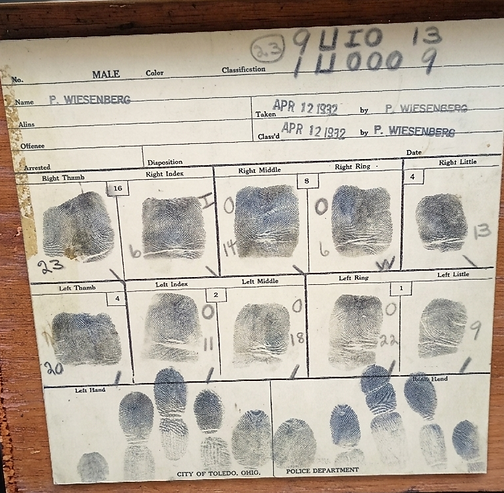
Fingerprinting has a rich history in the criminal justice system. When a subject is processed, one of the first steps is to take their fingerprints, which are then catalogued in a national database. While the process is largely digital, it began with the use of ink and paper, allowing law enforcement to track and identify criminals effectively. This method has evolved over the years, becoming a crucial tool in maintaining public safety and solving crimes.
Our Story
In 1906, Patrolman Richard F. McKey began taking inked fingerprints of known criminals for the Toledo Police Identification and Information Bureau. McKey learned the procedure from Mrs. Mary E. Holland, who had been instructed by Inspector Frost of the Finger Print Branch of New Scotland Yard. On May 12, 1913, Toledo City Council created by ordinance the Bureau of Identification (renamed the Bureau of Identification and Records soon after). McKey became the Superintendent of the Bureau on December 12, 1913.
Throughout the many decades since Officer McKey introduced the Toledo Police Department to the use of fingerprints, Police Officers, Detectives and civilian Identification Technicians have been collecting latent fingerprints at crime scenes as well as inked fingerprints of known criminals in order to solve crimes and identify offenders.
The current Records Bureau has gone by many names throughout the history of the Toledo Police Department. In the 1960’s and 1970’s when this wooden fingerprint table was in use, (now on display inside the Toledo Police Museum), the Bureau of Identification and Records (BIR) employees would go upstairs in the Safety Building to the men’s and women’s jails and process the prisoners. They would roll fingerprint cards if the crime the prisoner was charged with warranted their fingerprints to be sent to the Bureau of Criminal Identification and Investigation (BCI) or The Federal Bureau of Investigation (FBI). They would also photograph the prisoner and create a felony package where every time the suspect was arrested, all the fingerprints were stored so they could be compared.
During this time, police officers would also scour the daily obituaries in the Toledo Blade. An officer would then visit funeral homes to verify deceased person’s identities by fingerprinting them and comparing the prints to the ones the department had on file.
The civilian police technicians who assisted in BIR at this time were disabled veterans who were hired with federal grant money (Part of the President Jimmy Carter administration expansion of the Comprehensive Employment and Training Act or CETA).


There is always more to the story . . .


During one of his journeys to the American Southwest, James Boyd, an attorney and professor at the University of Toledo, uncovered a fragment of earthenware in New Mexico. Believing it contained an ancient fingerprint, Mr. Boyd submitted it for analysis to Paul Wiesenberg, the leading forensics investigator in Toledo at the time. The pottery fragment, received on September 28, 1926, was recorded as likely having been created by the ancestors of the Pueblo Indians in Sandoval County, New Mexico, approximately 500 years ago. After remaining in storage for several decades, staff from the Toledo Police Museum brought the fragment to the 20th Anniversary ID Day at the University of Michigan in 2016, where experts in natural history and anthropology determined that it could be as much as 700 years old, potentially making this "pebble" the oldest artifact in the Toledo Police Museum. The existence of a fingerprint on the fragment remains uncertain.